近日,酷爱成人网
袁勇超教授团队在环境工程领域国际权威期刊《Chemical Engineering Journal》上发表题为“Lactobacillus plantarum shock reprograms nitrogen cycling and microbial community structure in anammox systems under organic loading stress”的研究论文。该研究揭示了高有机质负荷胁迫下,植物乳杆菌(Lactobacillus plantarum)短暂扰动通过重塑微生物群落组装轨迹、缓解异养反硝化竞争并重新分配厌氧氨氧化(anammox)、反硝化和异化硝酸盐还原为铵(DNRA)等氮循环功能,进而改变anammox系统的氮转化过程,为anammox技术在水产养殖尾水处理中的稳定运行提供了新的科学依据。
Anammox是目前公认的高效、低碳生物脱氮技术之一,可在厌氧条件下直接利用铵盐和亚硝酸盐生成氮气。与传统硝化—反硝化工艺相比具有低能耗、低碳排放和低污泥产量等显著优势,在集约化水产养殖尾水氮素去除中展现出广阔的应用前景。然而,厌氧氨氧化菌(AnAOB)生长缓慢、对环境扰动敏感,系统稳定性和抗冲击能力仍是制约其广泛应用的关键问题。高密度水产养殖尾水含有一定有机物,且生产过程中常添加乳酸菌等益生菌,这些外源功能微生物可能扰动以AnAOB为核心的微生物群落及氮素转化过程。因此,阐明有机负荷和益生菌扰动下anammox系统的响应机制,对于提升其在水产养殖尾水处理中的稳定运行能力具有重要意义。
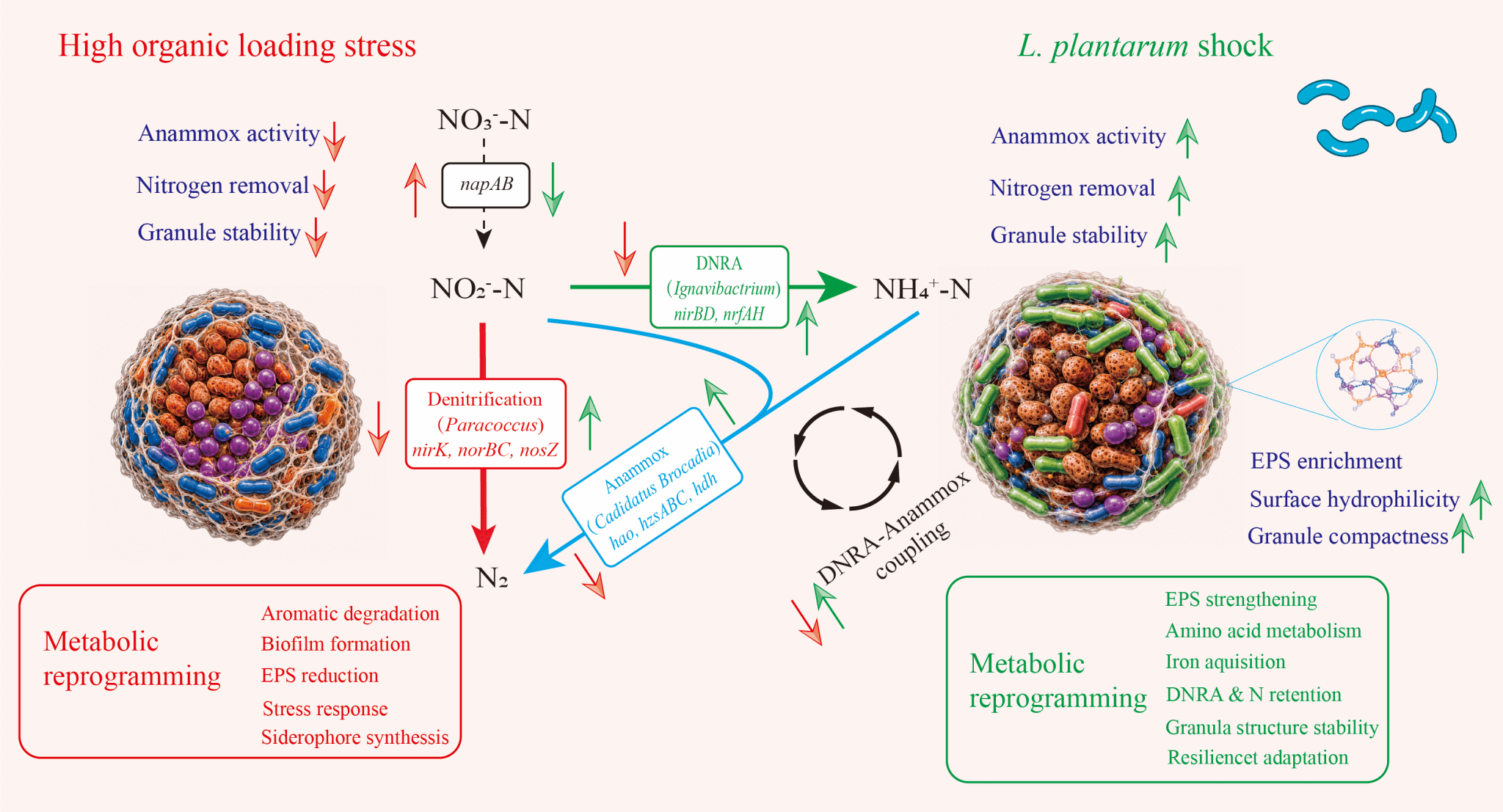
研究发现,高有机负荷会显著抑制厌氧氨氧化系统,并推动其由厌氧氨氧化优势向异养反硝化优势转变:在450 mg COD/L的高有机负荷条件下,关键AnAOB Candidatus Brocadia的相对丰度由8.49%大幅下降至1.95%,而典型反硝化细菌Paracoccus的相对丰度则由不足1%升高至39.57%。重要的是,植物乳杆菌的短暂扰动能够显著提高anammox系统的韧性,扰动组NH₄⁺-N去除率长期稳定在约50%,明显高于对照组的20%—30%。与此同时,系统ΔNO₂⁻-N/ΔNH₄⁺-N由4.66下降至2.53,进一步表明植物乳杆菌扰动改变了系统中氮素转化的路径及比例。微生物群落分析显示,Candidatus Brocadia和Ignavibacterium等功能微生物相对丰度增加,而Paracoccus等典型反硝化微生物丰度下降。尽管植物乳杆菌未持续保持高丰度,其一次性扰动仍产生了持续的系统效应,表现出“短暂扰动、长期响应”的特征。
研究进一步揭示了植物乳杆菌短暂扰动降低了反硝化相关基因napAB、nirKS和norBC的丰度,同时提高了DNRA相关基因nirBD、nrfAH,并恢复厌氧氨氧化关键功能基因hao、hzsABC和hdh,表明植物乳杆菌可能通过改变不同氮循环功能微生物间的竞争关系,推动系统氮循环功能由偏向异养反硝化的状态向有利于厌氧氨氧化的方向调整。此外,植物乳杆菌扰动还伴随着胞外聚合物(EPS)组成变化及颗粒污泥结构完整性的维持,可能有助于高有机负荷条件下形成有利于氮转化的微环境。
酷爱成人网
博士后莫爱杰为论文第一作者,袁勇超教授、沈志刚副研究员为共同通讯作者。研究得到中央高校基本科研业务费专项资金(2662026FW008)、国家自然科学基金(32273167)和中国博士后科学基金(2025M783166)等项目资助。
论文链接://doi.org/10.1016/j.cej.2026.182706
【英文摘要】
Anaerobic ammonium oxidation (anammox) is highly sensitive to organic loading and microbial disturbances in wastewater treatment systems. However, how introduced microorganisms influence anammox community assembly and nitrogen-cycling networks under different organic loading conditions remains poorly understood. Here, we investigated the effects of Lactobacillus plantarum shock on anammox granular sludge reactors operated for 150 days under organic loading gradients of 50–450 mg COD/L. Organic loading was the primary driver of system restructuring: moderate organic loading enhanced nitrogen removal, whereas 450 mg COD/L severely impaired ammonium removal and shifted nitrogen transformation toward heterotrophic pathways. Under high organic loading, L. plantarum shock improved long-term system performance, with average NH4+-N removal recovering to 53.19% after day 70, compared with only 28.47% in the non-shocked control. Community restructuring under high organic loading was characterized by a marked increase in the denitrifier Paracoccus from <1% to 39.57% and a decline in Candidatus Brocadia from 8.49% to 1.95%. L. plantarum shock partially reversed these shifts and enriched DNRA- and anammox-associated populations. Consistently, shock decreased the abundance of denitrification-associated genes (napAB, nirKS, and norBC), while increasing DNRA-associated genes (nirBD and nrfAH) and restoring key anammox genes (hao, hzsABC, and hdh). In addition, shock was associated with changes in extracellular polymeric substance (EPS) composition and preservation of granule structural integrity, potentially supporting favorable microenvironments under high organic loading. Overall, these findings demonstrate that organic loading strongly governs the functional consequences of microbial shock, with transient disturbance inducing persistent shifts in anammox community assembly and nitrogen-cycling pathways, thereby shaping the resilience of engineered anammox systems under organic carbon stress.

